
Permission to Care
Why baseball may be the last place where adults gets to feel this much

The Mariners played a completely lifeless form of baseball last Friday night.
It started in the first inning. With nobody on base, Randy Arozarena managed to burn both of the Mariners’ ABS challenges during the same at-bat. Everyone in my section let out a collective groan at Randy’s incredibly poor judgment and, frankly, deeply selfish move in that situation. It was weakly hit ball after weakly hit ball, strikeout after strikeout, a potential rally erased by a double play, and a handful of mental mistakes that made the whole thing feel even sloppier than the final score suggested. It might as well have been a 12-0 loss.
I wasn’t alone in my frustration. The row in front of us had something to say after nearly every at-bat. Every strikeout was met with another groan. Every inning seemed to end with people throwing their hands in the air. And because the Blue Jays were in town, T-Mobile Park was once again filled with thousands of fans who had made the trip south from British Columbia. As the Mariners sleepwalked through another inning, half the stadium seemed frustrated while the other half was having a wonderful evening.
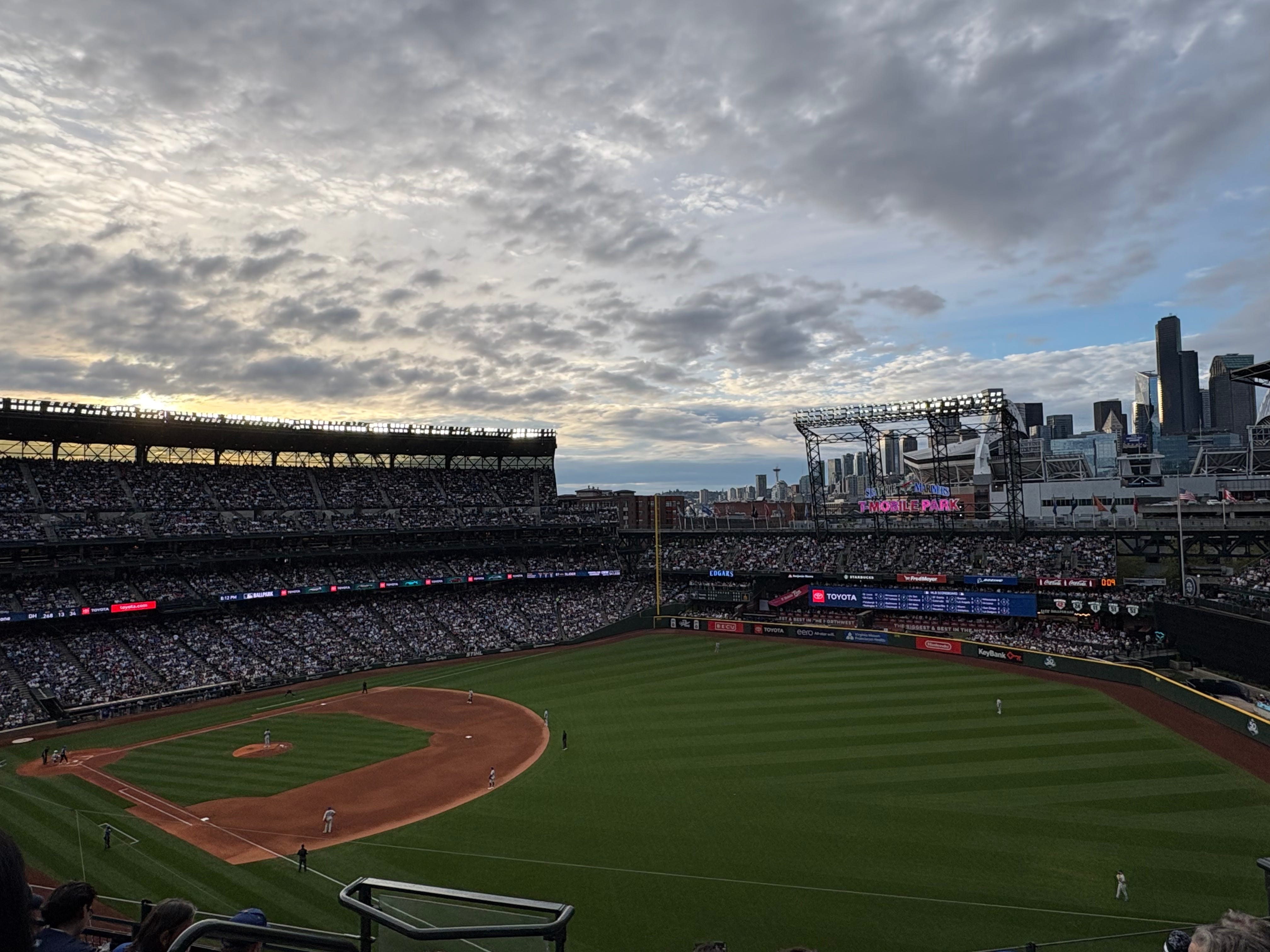
It was Friday night, and the game would be followed by a fireworks display. I was there with my partner and stepson. It was a perfect summer night in the Pacific Northwest. All of the ingredients were there for me to simply enjoy myself. Instead, I found myself increasingly annoyed by the way the Mariners were playing.
On the trip home, I kept rehashing the same question: Why do I care this much?
Nothing of any real importance in my world had changed between first pitch and the final out. The bills were still piled up on my desk. My search for new clients continued. Everything remained fantastic with my family. The people I love were still doing just fine. A 2-0 loss to the Blue Jays hadn’t had any impact on anything that mattered.
And yet, for nearly three hours, that baseball game had my complete emotional attention.
I’ve written before about why we stick with our teams through difficult times, but this felt like a different question. Why do we willingly sign up for frustration? Why do millions of otherwise rational adults let a baseball team determine whether they drive home happy or irritated? Why do we voluntarily put ourselves through this same charade over and over again? There are 162 games in a baseball season. That affords us a lot of opportunities for irritation and annoyance.
At first, I thought maybe it was expectations. This Mariners team was supposed to be good. Many thought they were the best in the American League and serious World Series contenders. But that didn’t really hold up in my mind. I’ve been just as frustrated by teams that had no business competing for a playoff spot.
The more I thought about it, the more I realized the answer probably had very little to do with the Mariners at all.
In my work, I spend a lot of time talking about emotions. One of the things I tell leaders is that emotions aren’t the enemy. They become a problem when we let them become directors instead of advisors. Frustration can tell us that something isn’t working. Anxiety can tell us we need to prepare better. Those emotions have value, but they probably shouldn’t be making our decisions.
Most of adulthood works like that.
At work, we have to keep our cool. In our relationships, we choose our words with precision, always careful not to unintentionally hurt feelings and cause upset. As parents, we try (and in my case, often fail) not to overreact. Every important part of our lives asks us to be somewhat measured because the consequences of poor temperament are real.
Then baseball comes along.
For three hours, almost none of those rules apply.
You can yell at the television. You can complain about the manager’s bullpen decisions (a common theme for Mariners fans) and spend an entire inning convinced that one error or taking a perfect pitch for a third strike has ruined your evening. You can celebrate with strangers after a home run or sit there muttering to yourself because someone couldn’t lay down a perfect bunt.
It’s irrational and completely unnecessary.
And I’m sure that’s a key reason why it’s so enjoyable.
After Friday’s game, I caught myself saying what I’ve said many times before: “This team drives me crazy.” The more I thought about it, the more I realized that another way of saying the same thing is to simply say, “I care.”
And not just a little.
Enough that a meaningless game in early July can still get under my skin.
I don’t think that’s the downside of being a devoted fan. I think it’s an enormous part of the gift. If the losses didn’t sting, the wins wouldn’t feel so great. If there wasn’t the potential for frustration, there wouldn’t be that delightful anticipation that precedes every game. It’s only meaningful to have hope if the potential for disappointment is always sitting right next to it.
As we left the ballpark, I was still thinking about all the moments in the game that had driven me crazy.
But by the time I got home, I wasn’t thinking about that night’s game anymore. I was wondering who was pitching on Saturday. Whether they could still win the series. Whether this was just one bad night or the beginning of another stretch where the offense disappeared. But mostly I was just thinking about what came next. Because it’s baseball. And with baseball, that’s just what you do.
For me as a kid baseball always was one place where life had no stress, all that mattered was the game. I lived and died with the Yankees but things weren’t life and death like they were outside the stadium walls. The importance I place on games these days is almost me honoring my younger self. I know Anthony Volpe striking out yet again with runners on base really doesn’t matter, but there’s probably some kid out there who needs the team like I did back when, so put the bat on the damn ball for once, Volpe.